This is my very first post on this blog! I would like to talk about the fundamentals of sleep and how it is quantified. Hopefully it will make you stop and think of processes that occur during sleep and how it is quantified.
Based on an average human lifespan, a person will spend around 26 years sleeping. A very long time indeed!
Sleep allows for a complex pattern of physiological processes. We can identify sleep very accurately across the animal kingdom in terms of posture, minimal movement, reduced response to external stimuli and that this state of sleep is reversible with adequate stimulation – the person wakes!
Sleep is not one passive process, it is a very active process composed of several stages.
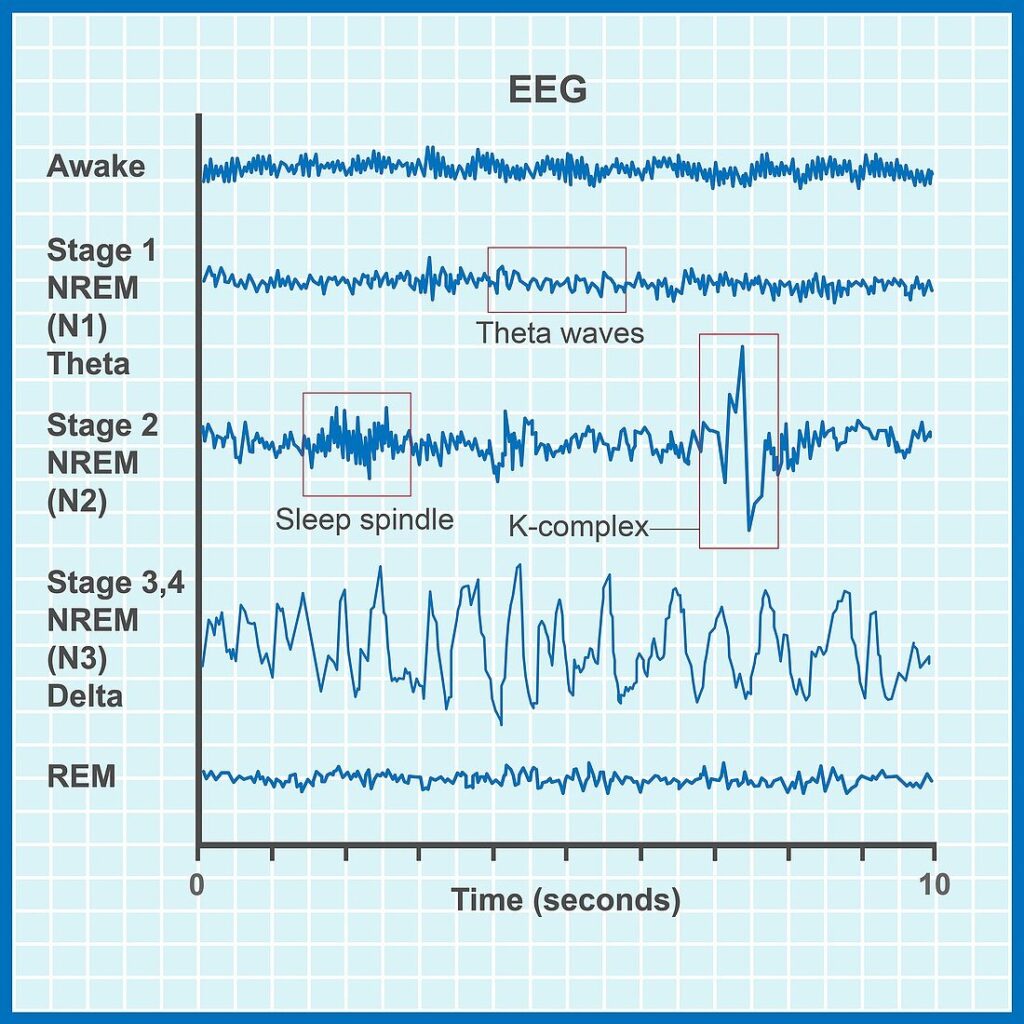
NREM (Non Rapid Eye Movement) Stage 1: Drowsiness/light sleep. This is the transition from wake to sleep. The EEG shows small wave frequency. Muscle activity slows and person can be easily woken.
NREM (Non Rapid Eye Movement) Stage 2: Person is asleep. Deeper light sleep which makes up the largest proportion of the total sleep. The EEG is dominated by Theta waves and Sleep Spindles.
NREM (Non Rapid Eye Movement) Stage 3. Slow Wave deep sleep. Delta Waves present.
NREM (Non Rapid Eye Movement) Stage 4. Deepest stage of NREM. Delta Waves present. Difficult to wake person.
REM (Rapid Eye Movement) also known as Paradoxical Sleep. EEG is fast with Alpha Waves. No muscle tone to ensure person does not act out dreams.
Sleep progresses through cycles of NREM and REM sleep. Each lasting 90 – 110 mins on average. With a person experiencing four to six cycles during a normal night’s sleep.